




MODIFIED ON: June 8, 2026 / ALIGNMINDS TECHNOLOGIES / 0 COMMENTS

If you’ve searched “how much does software development cost” lately, you’ve probably landed on wildly different numbers – anywhere from $10,000 to $2 million. That’s not confusion, that’s the reality of building software in 2026, where the scope, team, and technology stack you choose can move the needle dramatically.
This guide cuts through the noise with real numbers, a clear breakdown by project type, and practical advice on where businesses can genuinely save, without sacrificing delivery quality.
What’s Driving Software Development Costs in 2026?
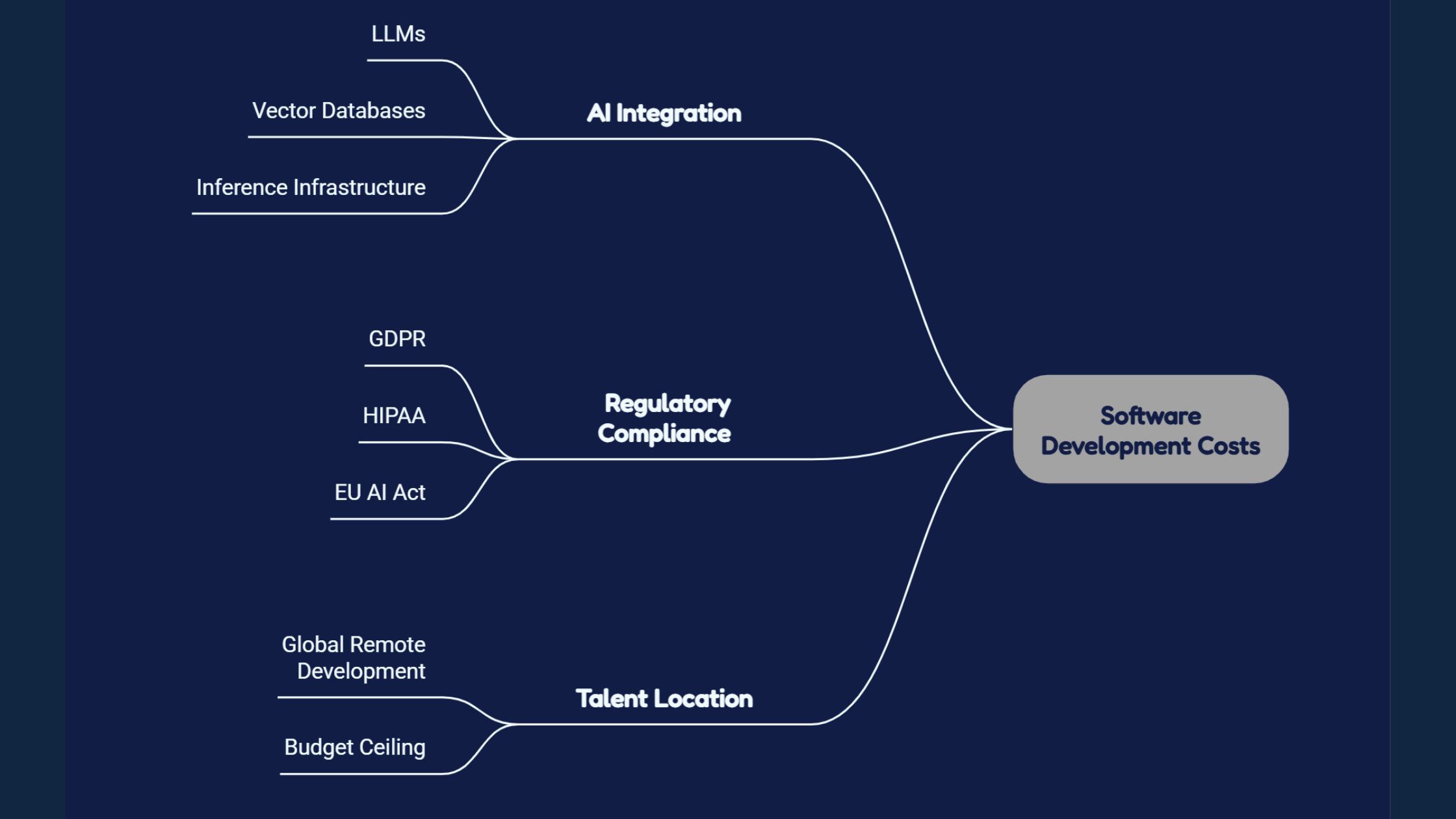
Before looking at the numbers, it’s worth understanding why costs have shifted. Three major forces are reshaping budgets this year:
1. AI is now a baseline expectation, not a bonus feature.
Integrating LLMs, vector databases, and inference infrastructure into products adds layers of cost that traditional development estimates never accounted for. Businesses that treat AI as a simple API plug-in almost always underestimate total spend.
2. Regulatory compliance isn’t optional.
From GDPR and HIPAA to the EU AI Act (which takes full effect in August 2026), compliance requirements add 10–50% to project costs depending on your industry. Healthcare and fintech projects feel this the hardest.
3. Talent location has never mattered more.
With global remote development now the standard, where you hire determines your budget ceiling as much as what you’re building.
AI & Software Development Cost by Project Type
Here’s a realistic breakdown for 2026 based on project complexity:

These ranges assume a professional development team, proper QA, and post-launch maintenance. Cutting corners on any of these typically creates a larger reinvestment down the line.
How Developer Location Affects Your Budget
Team geography is the single biggest lever in controlling costs. Here’s what the market looks like in 2026:
1.USA / Western Europe: $100–$200/hour (blended team rate)
2.Eastern Europe: $50–$85/hour
3.India: $25–$65/hour (junior to senior AI engineers)
4.Southeast Asia: $25–$50/hour
India remains the world’s dominant offshore development destination – not just on price, but on depth of AI/ML specialization. India produces over 1.5 million IT graduates annually, with a particularly strong talent pipeline in Python, cloud-native architecture, and generative AI.
For context, a project that costs $425,000 with a US-based agency can deliver the same technical output for roughly $280,000–$300,000 with a senior Indian development partner – that’s a saving of 30–50% without any compromise in architecture quality.
The Hidden Costs Most Estimates Miss
This is where most cost guides stop short. The quoted price is rarely the final price. Watch for these:
→Data preparation:
Typically adds 25–40% on top of AI engineering costs
→Cloud and inference compute:
Ongoing cost that scales with users, often 15–25% of engineering spend
→Rework from poor QA:
Industry studies show 15–30% of offshore project hours go toward rework when QA isn’t built into the process from day one
→Integration complexity:
Each new system connection adds $5,000–$25,000 to the estimate
→EU AI Act compliance:
For high-risk AI applications, budget an additional 10–25% for risk documentation, transparency audits, and post-market monitoring
The best development partners surface these costs upfront rather than absorbing them into change orders mid-project.
What Affects the Final Number Most?
Whether you’re building an internal tool or a market-ready AI product, five variables shape your final cost more than anything else:
➣Complexity and feature depth – every integration, user role, and data pipeline multiplies effort
➣AI model strategy – custom training vs. fine-tuning vs. API-based integration have very different cost profiles
➣Team seniority and specialization – generalist developers cost less upfront but create expensive architectural debt
➣QA and testing rigor – front-loading quality reduces total spend, not the other way around
➣Post-launch support – an app without a maintenance plan is a liability, not an asset
How to Get an Accurate Estimate
A reliable estimate starts with a discovery engagement. This means scoping your requirements in detail, mapping integrations, agreeing on a tech stack, and stress-testing assumptions before a single line of code is written.
At AlignMinds Technologies, this is built into how we work. We’re a Kochi-based software and AI development company with teams that specialize in mobile apps, enterprise platforms, and AI-integrated products. Our discovery process gives clients a realistic cost picture before committing to full development – so there are no surprises at sprint 6.
If you’re planning a software or AI project in 2026, let’s talk. Share what you’re building and we’ll give you a transparent scope and estimate – no vague ranges, no generic advice.
Frequently Asked Questions
1.How much does it cost to build an AI app in 2026?
An AI-powered application typically costs between $80,000 and $400,000 depending on whether you’re using third-party LLM APIs or building custom models, and how deeply AI is embedded in the product.
2.Is offshore AI development reliable?
Yes – when the partner has proven AI/ML expertise, a documented QA process, and a clear escalation structure. India-based teams in particular have a deep track record in enterprise-grade AI products.
3.What’s the cheapest way to build software without compromising quality?
Working with a senior offshore team on a fixed-scope engagement with proper discovery and defined acceptance criteria is the most cost-effective approach for most companies.
4.How long does custom software development take?
A simple app takes 3–5 months. A mid-complexity SaaS product typically runs 6–12 months. Enterprise AI platforms can take 12–18+ months depending on integrations and data complexity.
Looking to build something in 2026? Talk to AlignMinds – a software and AI development partner trusted by start ups and enterprises across 15+ countries.
Leave a reply
Your email address will not be published.
-
Recent Posts
- Top Product Engineering and Product Modernization Partners for European Enterprises
- Legacy Application Modernization: When Should Enterprises Rebuild, Refactor or Replace?
- When AI Coding Tools Aren’t Enough: What Enterprise Engineering Teams Still Need
- Build vs Buy vs Partner: How Enterprises Should Approach AI Development
- How to Make an Existing Product AI-Ready Without Rewriting the Entire Tech Stack
-
Categories
- MVP Development (5)
- AlignMinds (77)
- Operating Systems (1)
- Android POS (4)
- Application Hosting (1)
- Artificial Intelligence (95)
- Big Data (2)
- Blockchain (1)
- Cloud Application Development (10)
- Software Development (50)
- Software Testing (9)
- Strategy & User Experience Design (4)
- Web Application Development (28)
- Cyber Security (6)
- Outsourcing (7)
- Programming Languages (3)
- DevOps (5)
- Software Designing (6)
- How to Code (4)
- Internet of Things (1)
- Machine Learning (3)
- Mobile App Marketing (7)
- Mobile Application Development (28)
- Mobile Applications (12)